

Researchers' Journal
We use student-generated projects and photographic documentation produced during field-based educational activities as qualitative materials to illustrate and analyze processes of intergenerational collaboration and community-based learning.
01-Yang Li Fang
By Sally (Meiying) Li
What I Found Most Important

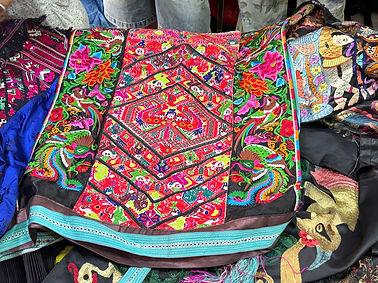
During our field research in Guizhou, what struck me most was the central role women play in sustaining cultural heritage. Across ethnic minority villages, women’s embroidery and craftwork carry generations of knowledge, identity, and ecological values. Yet this cultural labor is rarely recognized as formal economic activity. For many women, heritage production exists alongside farming and caregiving, positioned as supplemental rather than professional work. This gap between cultural value and economic recognition emerged as the core issue shaping women’s livelihoods and leadership opportunities.
Challenges and Opportunities
Our research revealed several structural challenges. Women artisans often face limited access to education, digital tools, and market information, restricting their ability to scale or stabilize their work. Employment remains informal and seasonal, while leadership and decision-making roles are frequently dominated by men despite women’s cultural expertise. At the same time, we observed growing opportunities. Youth engagement is increasing, digital platforms are lowering market barriers, and younger women are beginning to reinterpret heritage through contemporary design and storytelling. These shifts signal the potential for transformation if adequate support structures are in place.
Pathways for Action

Addressing these challenges requires coordinated policy innovation. Education and digital skills training are essential to enable women to manage, brand, and market cultural products. Improved market access—through micro-finance, cooperatives, and certification systems—can stabilize income while protecting cultural authenticity. Equally important is expanding women’s leadership opportunities, positioning them not only as artisans but as entrepreneurs and decision-makers. Cross-sector partnerships among governments, NGOs, technology platforms, and cultural institutions can provide the institutional scaffolding needed for sustainable growth.
Conclusion
Our experience in Guizhou demonstrates that women are already the backbone of cultural continuity and local resilience. The challenge lies not in preserving heritage, but in ensuring that those who sustain it are able to benefit from it equitably. With targeted policy support, education, and inclusive partnerships, women-led cultural enterprises can become drivers of socioeconomic development and climate resilience. Supporting women in this transition is not only a matter of equity—it is central to building sustainable futures where culture and economy evolve together.


02-Cen Studio
By Yicen Lin
Yi Cen (林奕岑) is the founder and creative director of the independent Miao silver jewelry brand Cén (岑), established in 2023 in Qiandongnan, Guizhou. Trained in art and design, Yi Cen first arrived in Guizhou through a personal encounter with traditional Miao silverwork, which led her to remain in the region and study silversmithing directly with local artisans. Rather than approaching heritage as an external observer, she embedded herself in everyday craft practice, learning through apprenticeship, co-production, and long-term collaboration.
Yicen's Story
Yicen first came to Guizhou in 2023 and encountered Miao silverwork not through a project plan, but through everyday life—walking through local markets and seeing traditional silver ornaments hanging densely in small shops. What struck me was not only the visual power of the work, but the depth of skill and cultural logic embedded in each piece. I decided to stay and learn directly from local silversmiths, realizing that this craft carries generations of knowledge yet remains largely disconnected from contemporary design and stable livelihoods.


What matters most to young entrepreneurs is that cultural heritage should not be treated as something frozen or symbolic. Yicen do not copy traditional patterns; instead, she studies the structural logic of the craft—how materials behave, how forms move with the body, and how artisans work through time. For me, true inheritance is not preservation as repetition, but allowing tradition to continue evolving within everyday life.
Equally important is how we work with people. Sustainable craftsmanship depends on fair labor, long-term collaboration, and respect for professional boundaries. Paying artisans fairly, maintaining slow production rhythms, and reinvesting in local communities create the conditions for skills to be passed on across generations.
We believe cultural heritage has economic potential when it is reconnected with contemporary life through honest storytelling and real relationships. When people understand who made an object, how it was made, and why it matters, heritage becomes not only something to admire, but something that can support lasting livelihoods and cultural continuity.


